It’s hard to believe, but it’s been nearly three months since we brought Barley home. She’s made a lot of progress since then, the most obvious example of which is the fact that she is now completely house trained. (Cue music, confetti, fireworks, and exploding bottles of bubbly.)
It took about 5 weeks for her to learn to only go to the bathroom outside, and we’ve gotten to the point where when she needs to go to the bathroom, she’ll go up to the front door, ring a bell that hangs on the doorknob, and sit down to wait for one of us to take her out.
…it’s amazing.
Those first few weeks, however, were a bit difficult. She’d whine in the crate at night, have to go outside every hour and a half, and had more than her fair share of accidents indoors. But with a regular schedule and a fair amount of homemade treats (scroll down for the recipe), she’s doin’ pretty well so far (this is not at all to say that she’s the perfect pup. We’ll get into behavioral problems later!).
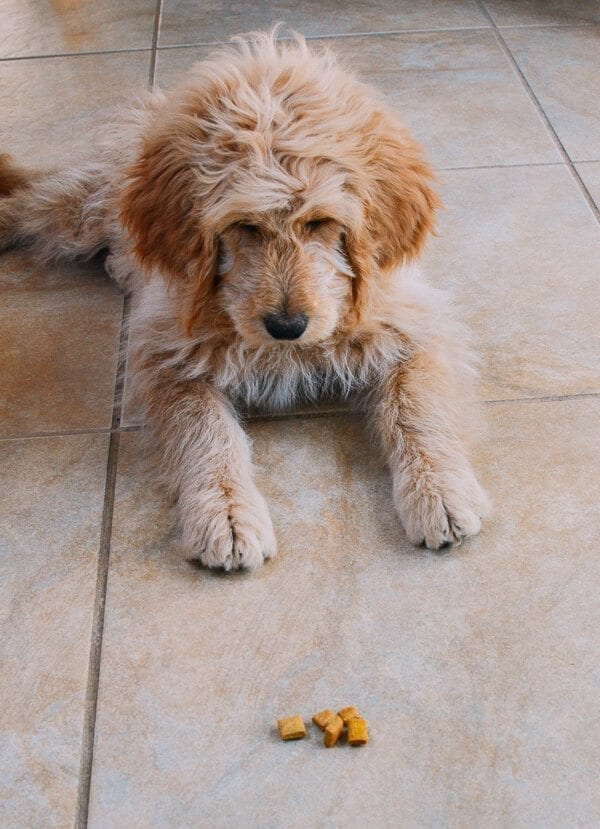
Here are some of the things we did to get her to this point. We know that there’s a lot of debate among trainers, dog owners, etc. about training techniques. As a bit of a disclaimer for this post, it’s important to remember that every dog is different and that these are just the experiences of one harried family! A dog’s individual personality, age, and temperament all play a big part in figuring out effective training methods, but hopefully you can get some insight or at least some much needed empathy from this post!
Barley: The First Few Weeks
The first night:
The first night, Barley whined in the crate like crazy. We quickly realized that she was yelping and crying because she had always been around her litter mates. Being left alone as we all retreated upstairs for bed felt like the pack was leaving her behind.
When someone was in sight, she would stop whining. So we needed to let her know we were still around. Eventually, I (Kaitlin) decided to sleep on a mattress on the floor next to her crate for the first week. (This resulted in the unfortunate reversal of ALL my hard work over winter break sleeping to rid myself of finals-induced eye bags.)
We then kept her within earshot for the next week since we had to let her out in the middle of the night to do her business. A couple of reassurances after midnight outings when she would go back into the crate and even the sound of breathing went a long way in comforting her enough to go back to sleep.
Puppies can only hold their bowels for 2 hours or so at a time when they are less than 10 weeks old. But on the 3rd week, she graduated to sleeping a full 6 hours, which, as you can imagine, was epically amazing.
House training:
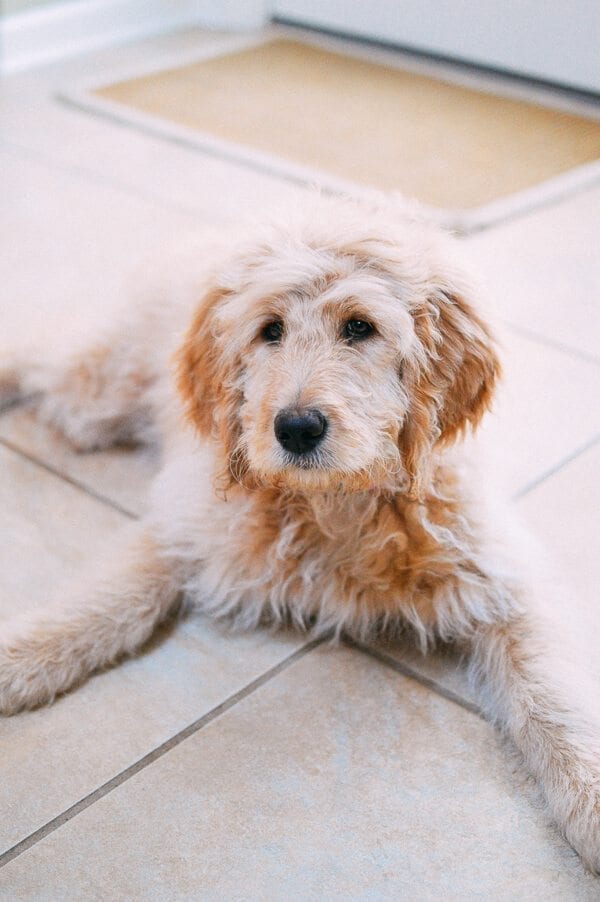
The most crucial part of house training is your dog’s crate. The crate becomes their den, and they will never willingly soil it…in theory. Before Barley came home, we prepared Jake’s old crate by reducing it down to puppy size. With a few well-placed boxes, there was only room enough for her to turn around and lie down. Any bigger than this and you risk your puppy partitioning the crate into a “sleep” side and an “emergency poo” side.
One thing we’ve learned from our excessive book reading and checking of internet resources is that puppies should have a solid schedule and rules in order to develop good habits from the start. Weeks 8 to 16 are really important to establish boundaries and foundations for obedience and discipline.
From the books we read (of which there were many), we chose the Monks of New Skete’s The Art of Raising a Puppy (Revised Edition) and How to Be Your Dog’s Best Friend as our go-to references. All jokes about these soft-spoken, doggie whispering men aside, the Monks of New Skete know. Their. Stuff. Barley seems to cycle through every puppy problem conceivably known to man, and these books have been indispensable.
After the first few days, we quickly realized that a regimented schedule was needed for house training. Based on the monks’ recommendations, Sarah created a crate training schedule that looked something like this:
Morning/7:00 AM:
- Wake up and go outside
- Breakfast, offer water
- 10 minute play session
- 15 minute walk
- Return to crate
10:30
- Offer water
- 10 minute walk
- 10 minute play/training session
- Return to crate
12:30
- Lunch, offer water
- 10 minute walk
- 10 minute play/training session
- Return to crate
2:30
- Offer water
- 10 minute walk
- Return to crate
5:30
- Dinner, offer water
- 10 minute walk
- Station in kitchen while dinner’s prepared.
7:30
- Last offer of water. Water cut off after this.
- 10 minute play session
- 10 minute walk
- Station in family room/living room.
Before bed/10:30 PM
- 10 minute walk
- Return to crate for bed
Obviously, you have to be mildly insane to get a puppy.
They’re a lot of work, man.
So there are a few more things that we learned about house training with Barley:
- We always kept her on a leash, even indoors (unless she was in her crate), to familiarize her with it. This also made it a lot easier to catch her when she looked like she need to go outside or when she was misbehaving. Plus, you’ve got a living, breathing dust buster for bits of food that fall to the kitchen floor at opportune times!
- We put a bell on the doorknob, so that she could reach it. Every time we took her out, we made her sit by the door, rang the bell, and took her out. This really paid off in a few weeks, because Barley now goes to the door, nudges the bell, sits, and waits patiently for someone to take her out. When this happened for the first time and each time after, lots of praise was in order! (We tied two old Christmas ornament bells to a cheap old belt and looped it over the door knob. But you can also buy one here).
- We started using a keyword for ‘elimination’ when she was outside and in the act. We used “go poop!” (classy, right? try continuously repeating those words in front of your neighbors on a daily basis), repeating it quietly when we were outside with her until she went to the bathroom, and followed the whole shebang with praise.
- This might sound kind of gross, but it also helped to leave a few puppy turds around the elimination area so that when she went in for a casual sniff, we could associate our phrase with the smell and the act of elimination. (Have you had your fill of poop talk yet? No? Good. Carrying on!)
- We really kept track of the time during housebreaking. When the time since the last elimination exceeded an hour, we were on alert. If she started sniffing around, we acted fast and got her out the door.
- One point that seemed pretty common to all of the books we read: If a puppy does have an accident and is in the middle of eliminating, then say a curt “no!” to interrupt her (or screech like a crazy person, as my mom did…either one is effective), and immediately carry her outside. The interruption should distract her enough to make her stop and she will continue outside. But never discipline your puppy after the fact, because it’s not their fault if they went too long without a trip outside. And keep an eye on your puppy! Barley once laid down 3 heaping piles of poo before anyone noticed! That was a dark day…
- We ALWAYS ignored whining or barking while she was in the crate unless we really thought she had to go outside. Even then, we tried to wait for at least 1 minute of silence before letting her out. Barley is an EXTREMELY vocal puppy. If we responded at all to her whining, she would still be doing it today (which, thankfully…she isn’t).
Puppy food & diet:
When choosing a puppy chow, we went for something that had a protein as the first ingredient (“chicken,” “lamb,” “beef”). Ingredients like chicken and bone meal are not as good. These “protein-first” foods are also lower on grains (grain-packed foods require more volume to satisfy a growing pup). We feed Barley Nutro’s large breed puppy formula, which is also what Jake grew up on!
As for food bowls, Barley started right off with Jake’s adult-size, very indestructible stainless steel water and food bowls. At first, her head was so small that her floppy ears would mop up the food, but she’s grown into them in no time.
For those first few weeks, to ease the transition, we mixed mashed boiled carrots or plain pureed pumpkin with a splash of warm water into her kibble. We’ve also found that adding warm water to kibble helps expedite the bathroom sesh in the morning.
Plus, in the mornings she gets one scoop of plain full fat yogurt, to give her a healthy, shiny coat and to replenish good bacteria in her teeny little puppy body. This may sound strange, but she always goes for the yogurt first.
…It’s striking me at this point how incredibly spoiled this puppy is. #firstworldproblems
We feed her three times a day, and each time:
- We make her sit and stay before feeding her (we had to teach her those commands first of course).
- We don’t let her become pushy while preparing the food. Some days, Barley was so ravenous that she would jump on us to speed up the process and even bark at us (so RUDE). This kind of behavior was greeted with a firm no and a sit command.
- We use feeding times as opportune moments to teach/reinforce ‘sit’ and ‘stay.’ She doesn’t get her meal until she complies!
- While she’s eating, we pet her–near her head, her tail, etc. etc. to prevent food aggression and get her used to people touching her while she eats. Early on, she’d growl at this kind of tomfoolery. But she’s since stopped. This is especially important for households with kids.
- After she is done with half of her meal, we casually but quickly pick the bowl up. If she does protest, we calmly ignore it and repeat the stay command process. She’s learned that she’ll get the food back, and it’s gone a long way towards preventing food aggression.
Barley’s House Rules:
- Always allow humans to go through doorways first.
- Sit before going in or out of the house.
- Give good, concentrated eye contact before receiving a meal. (We established eye contact with her often early on, so she could learn our expressions of encouragement, happiness, or displeasure. Imagine how important eye contact and facial expressions are for communicating with someone who cannot talk. Barley is definitely keyed into our “want-a-piece-of-bacon?” face as well as the “you-got-some-splainin’-to-do” face.)
Barley’s Favorite Pumpkin Peanut Butter Puppy Training Treats
One fact every dog owner knows…dog treats are EXPENSIVE. And, truth be told, you really have no idea what’s in them. We decided to make homemade puppy training treats for Barley, because they’re much cheaper and very likely healthier. Plus, I enjoy the fact that I don’t feel like I have to wash my hands every time I touch these treats–which is more than I can say for your average “Beggin’ strip” or Milkbone.
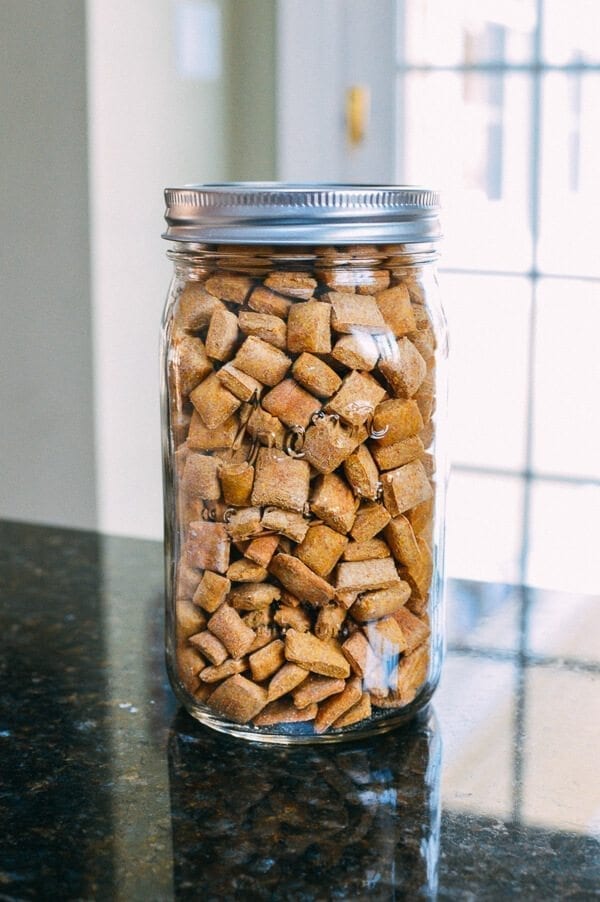
This awesome recipe comes from Use Real Butter, and Barley’s a big fan. Use Real Butter recommends cutting shapes out with cookie cutters, but since we wanted to use these treats for training, we decided to make them smaller by just cutting small squares–mini cookies!
There are only four blessed ingredients involved:
- 2 1/2 cups whole wheat flour
- 2 large eggs
- 2/3 cup pumpkin purée, canned or fresh
- 3 tablespoons peanut butter
Preheat the oven to 350°F. Add all the ingredients to the bowl of a stand mixer.
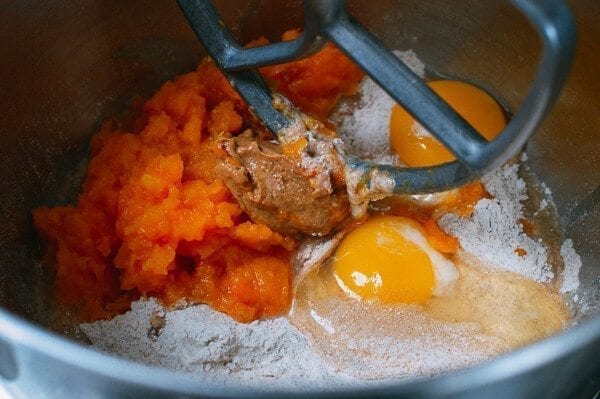
Using the paddle attachment, mix until combined.
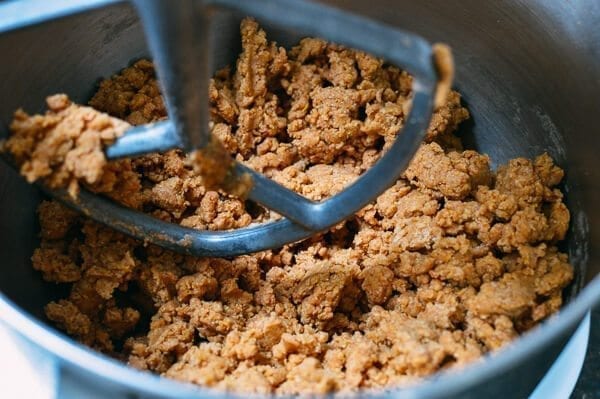
If it’s a little dry, add some water. If it’s wet, add a little more flour. Knead the dough together on a clean surface and roll it out really thin (between 1/8-1/4 inch thick).

Cut squares and continue rolling/cutting until all the dough has been used.
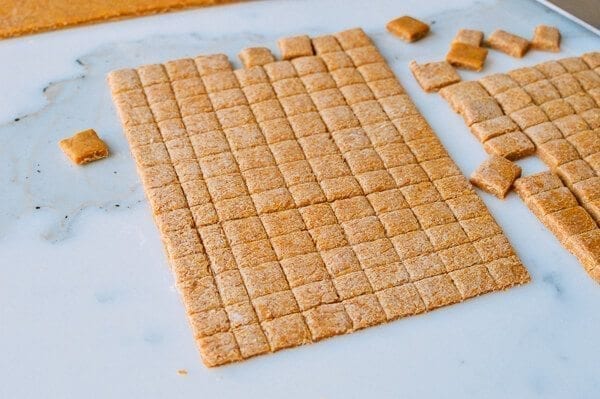
Transfer to an ungreased baking sheet and bake your puppy training treats for 25-30 minutes. It may take a little longer for these to get really crunchy, depending on the size and thickness.
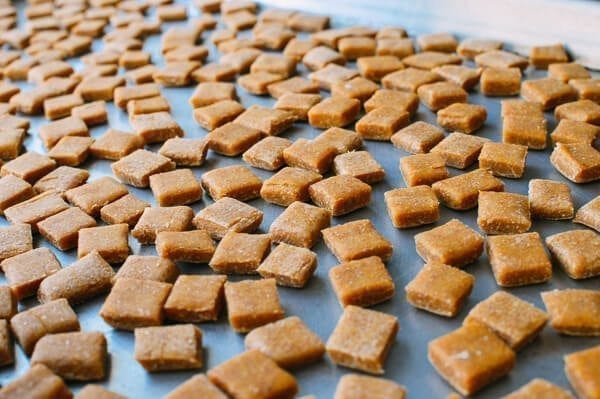
Once cooled completely, transfer to an airtight container and store for up to 2 weeks.
And that’s it for making these puppy training treats!
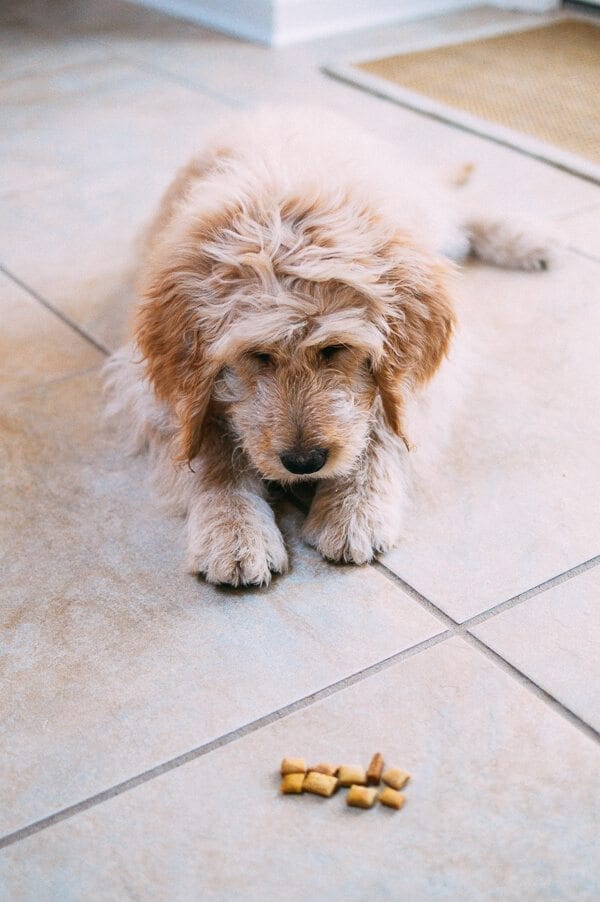
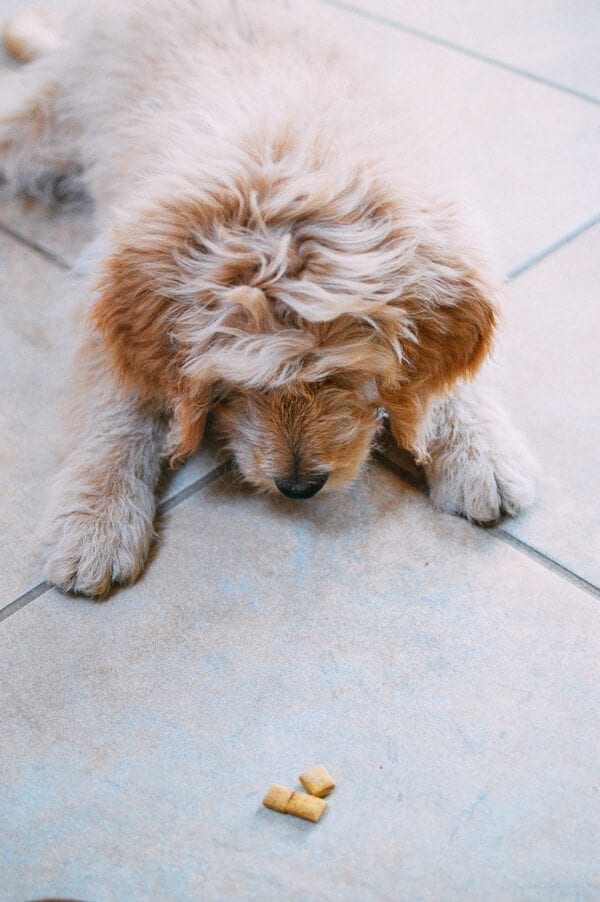
Did I mention that Barley loves these?

FAQs
You can prepare the dough ahead, wrap it tightly in plastic, and refrigerate for up to 2 days, or freeze it for up to 3 months. Then simply let the dough come up to room temperature before rolling and cutting out your treats.
You can, but the treats won’t be as nutritious or have as much fiber.
It’s important to bake these treats until hard and crunchy (like a Milkbone biscuit), or the moisture in the treats will reduce their shelf life.
Looking for more authentic recipes? Subscribe to our email list and be sure to follow us on Pinterest, Facebook, Instagram, and Youtube!
Recipe

Homemade Puppy Training Treats
Ingredients
- 2 1/2 cups whole wheat flour
- 2 large eggs
- 2/3 cup pumpkin purée (canned or fresh)
- 3 tablespoons peanut butter
Instructions
- Preheat the oven to 350°F. Add all the ingredients to the bowl of a stand mixer. Using the paddle attachment, mix until combined. If it's a little dry, add some water. If it's wet, add a little more flour.
- Knead the dough together on a clean surface and roll it out really thin (between 1/8-1/4 inch thick).
- Cut squares and continue rolling/cutting until all the dough has been used. Transfer to an ungreased baking sheet and bake for 25-30 minutes. It may take longer to bake them until crunchy, depending on how thin/thick you rolled the dough and the size of the treats.
Tips & Notes:
Nutrition Facts