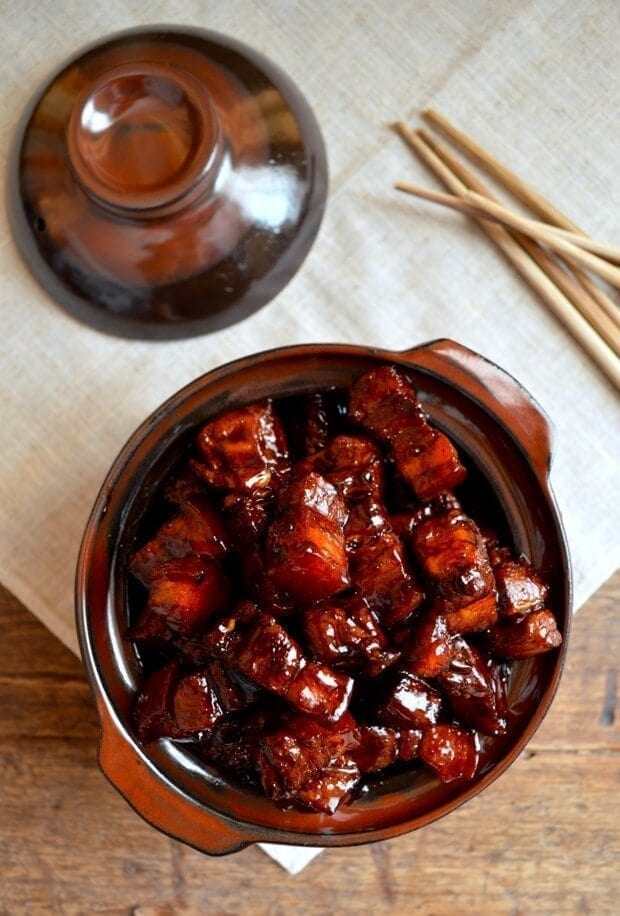
This Shanghai braised pork belly recipe, or hongshao rou, is simpler than you think to make, with just 6 ingredients (plus water).
Since we first published this recipe in 2014, soon after we first embarked on this journey to document Chinese recipes, this recipe has been a staple on The Woks of Life. If you haven’t made it yet, what are you waiting for?
A Delicious Indulgence
Braised pork belly is an every-once-in-a-while indulgence in our household. As we creep towards middle age, Bill and I try to be healthier and avoid eating too much meat.
We’re no health nuts by any stretch of the imagination…we’d eat anything and everything if all we had to worry about was the threat of pants that were a little too tight.
There are countless times when the two of us walk into a bakery or gourmet shop for the sole purpose of just going in to look. So for most of our home-cooked meals these days, we try to stay pretty healthy—lots of veggies.
But Shanghai-Style Braised Pork Belly (hóngshāo ròu in Mandarin – 红烧肉) is an exception! Rich pork belly combines with a sticky, sweet, savory sauce that anyone who’s tried it can’t resist. We always have pork belly in the freezer, and occasionally, when the mood strikes, we do indulge in this classic dish, as I learned to make it growing up in Shanghai.
Today, thanks to viewers like you, we’re having pork for dinner (and a vegetable, of course). We’re just giving the hungry public what they want, after all.
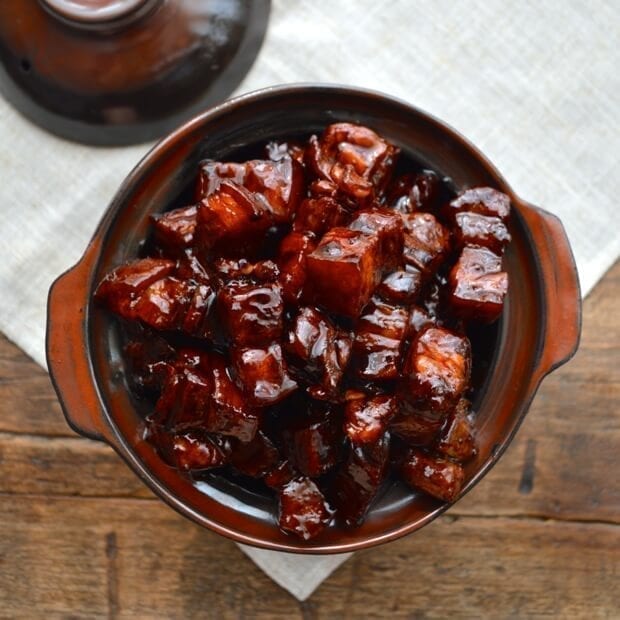

Look for lean, skin-on pork belly!
We know the term “lean pork belly” may sound like an oxymoron, but it really is possible to find very meaty pork belly, that’s leaner relative to extra fatty pork belly, which can be up to 70% fat! When I look for pork belly at my Chinese market (though our local Costco also sells it now too), I’m looking for thicker strips of meat and thinner streaks of fat. If your pork belly is meaty, but has some pieces that are mostly fat, you can trim them away and save them to make lard for other dishes and baked goods!
In China, that fat is prized. People don’t cut the fat out, because in the old days, eating pork belly may have been a once-a-year occasion. For a small village, slaughtering one pig was an annual event, and the animal was shared amongst everyone in the village. Why would you waste any of it?
To stretch that pork, it would have been sliced very thinly, with a small amount added to a stir-fry of mostly vegetables. This dish, which is all meat, and involves cutting the pork belly into thicker chunks, was very much reserved for special occasions.
These days, as China has modernized, incomes and access to rich food have increased. As in Western countries, some people can eat meat-heavy dishes like this anytime they want, and now avoid eating the fat on the pork belly. I say, eat it less often, and enjoy it as it was meant to be enjoyed, without waste!
Another important point is to look for skin-on pork belly. After braising, the skin has a delicious gelatinous texture. The collagen in the skin also helps give the sauce that shiny, sticky quality. That said, if you can only find pork belly without the skin, you can still make this recipe.
Video: Watch Me Make It! (And answer all the questions we’ve gotten over the years)

A Famous Chinese Dish
The Chinese term for this braised pork belly recipe (hóngshāo ròu – 红烧肉), literally means “red cooked pork.” Red cooking describes a braising technique using soy sauce, dark soy sauce, sugar, and rice wine to create a rich, reddish, dark-brown sauce.
The Importance of Dark Soy Sauce
A high quality dark soy sauce (such as Pearl River Bridge or Lee Kum Kee Premium) is particularly key to getting the color right. You can purchase it online, but if you can’t get it, you can try our dark soy sauce substitution. If you do get it, a bottle can last in your pantry for a year, and we have many dishes that use it! Just search “dark soy sauce” in our search bar.
Red Cooked Pork is a very famous dish in China. Everyone knows it, and there are many versions and twists based on the original.
Some of the more well-known variations include the addition of squid (sounds odd, but boy, is it tasty), hard boiled eggs (see our cookbook for that one), and tofu knots or puffs (one of Sarah’s favorites—we recorded my mother’s recipe for Hongshao Rou with this variation).
The list goes on (see more variations in the box below), but since I’m from Shanghai, I like to cook the original, un-embellished Shanghai-style version.
This Shanghai red cooked pork belly recipe uses 1 1/2 pounds of pork belly. It is designed for eight people as part of a larger Chinese meal with a couple other dishes, but if you serve it as the main event perhaps with a side vegetable, you may find it serves 4-6.
The ingredients are very simple: pork belly, oil, rock sugar or granulated sugar, wine, soy sauce, dark soy sauce. Just SIX ingredients. Crazy, right?
Braised Pork Belly Variations
There are countless variations on braised pork belly across China. Here are some favorites:
- Mao’s Braised Pork Belly: While it has this name in China, Mao did not invent the dish. It was simply a favorite of his. This is a Hunan variation on the dish, with added aromatics and a light chili heat.
- Dongpo Rou: A very famous variation in which larger chunks of pork belly are braised until very tender.
- Meicai Kou Rou: A well-known steamed dish using meigan cai (moy choy in Cantonese), a dried preserved vegetable.
- Braised Pork Belly with Meigan Cai: Our simpler version of mei cai kou rou, which is braised instead of steamed.
- Cantonese Braised Pork Belly with Arrowroot: This Cantonese classic dish (see goo mun fay gee yook) is commonly served around Chinese new year. Red fermented bean curd adds lots of flavor.
- Pork Belly with Pickled Mustard Greens: savory and tangy, the addition of sour pickled mustard greens counterbalances the richness of the pork belly. This version has become a family favorite.
And here are a couple modern variations from Sarah and Kaitlin!
- Instant Pot Braised Pork Belly: While not the same a true red cooked pork belly, it’s a fast dish cooked in a “master stock” in the instant pot.
- Red Braised Pulled Pork: Can’t find pork belly? Looking for a simpler version? Try this version, made with pork shoulder and braised in the oven.
Shanghai Braised Pork Belly: Recipe Instructions
Start by cutting your pork for your Shanghai braised pork belly. Cut the pork belly into 3/4-inch thick pieces.
Note:
You can make the pork belly pieces more square in shape (3/4-inch/2cm square) or more rectangular (3/4-inch thick by 1 1/2 inches wide—2x4cm).
The photos in this post are from two separate cooking sessions. The process photos show the rectangular pork belly, and the finished photos show the smaller square pieces.
As long as the pork is about 3/4 inches thick, you shouldn’t need to adjust the cooking time!
Add the pork to a medium pot and cover with water. Bring the water to a boil, and boil for about 1 minute, or just until the pork turns opaque. This gets rid of impurities and starts the cooking process. Take the pork out of the pot, rinse, and set it aside. Discard the water in the wok and clean it out.


Over low heat, add oil and sugar to your wok or pot. Melt the sugar slightly and add the pork.


Raise the heat to medium and cook until the pork is lightly browned.

Turn the heat back down to low and add Shaoxing cooking wine, and cook for a couple minutes to let the wine flavor infuse into the pork. Then add the regular soy sauce, dark soy sauce, and water. Add about 3 cups of water if using a wok, but if using a thick-bottomed pot (where the water will evaporate more slowly), use 2 1/2 cups. The water should mostly cover the pork belly.
It’s very important to the color and flavor of this dish that you have both kinds of soy sauce! Just head to your local Asian market, buy a bottle of each, and it will last you a year!
Cover and simmer over medium heat for about 45 minutes to 1 hour until pork is fork tender. Every 5-10 minutes, stir to prevent burning and add more water if it gets too dry. Once the pork is fork tender, if there is still a lot of visible liquid, uncover the wok, turn up the heat, and stir continuously until the sauce has reduced to a glistening coating.
And then, it’s time to eat! Let us know in the comments if you’re interested in any other variations of this dish, and we’ll get right on it. (not that we’re looking for another excuse to make it or anything…)
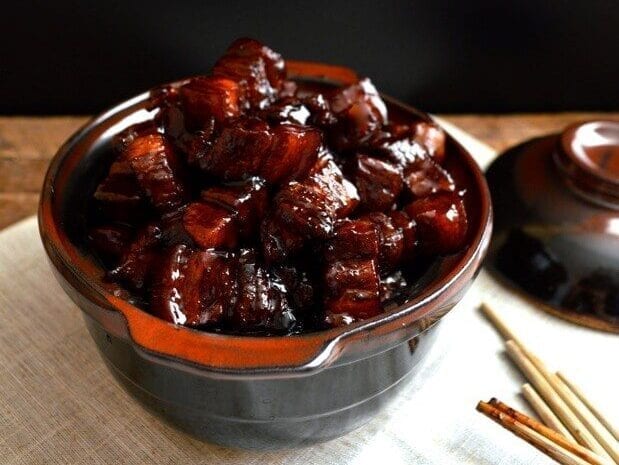
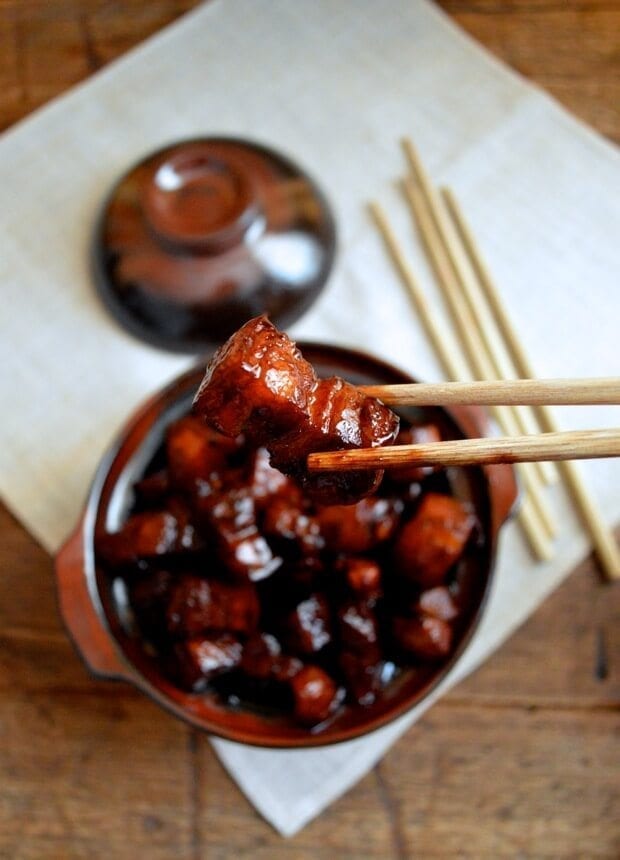
For entertaining, get one of these clay or earthen pots to serve your Shanghai Style Braised pork Belly (hong shao rou).
Looking for more authentic recipes? Subscribe to our email list and be sure to follow us on Pinterest, Facebook, Instagram, and Youtube!
Recipe

Shanghai-Style Braised Pork Belly (Hong Shao Rou)
Ingredients
- 1 1/2 pounds lean, skin-on pork belly
- 2 tablespoons oil (any neutral oil, such as canola, vegetable, or avocado oil)
- 2 tablespoons rock sugar (or granulated sugar)
- 1/3 cup Shaoxing wine (or dry cooking sherry)
- 2 tablespoons soy sauce
- 1 tablespoon dark soy sauce (see dark soy sauce substitute if needed; real dark soy sauce is important for color)
- 2-3 cups water (see note)
Instructions
- Cut your pork belly into 3/4-inch thick pieces. Add them to a medium pot and cover with water. Bring the water to a boil, and boil for about 1 minute, or just until the pork turns opaque. This removes impurities and starts the cooking process. Take the pork out of the pot, rinse, and set it aside. Discard the water and clean out your pot.
- Over low heat, add the oil and sugar to your wok or pot. Melt the sugar, and add the pork. Raise the heat to medium, and cook until the pork is lightly browned.
- Reduce the heat to low, and add the wine. Cook for 2 minutes, then add the soy sauce, dark soy sauce, and water.
- Cover and simmer over medium heat for about 45 minutes to 1 hour, until pork is fork tender. Every 5-10 minutes, stir to prevent burning and add more water if it gets too dry.
- Once the pork is fork tender, if there is still a lot of visible liquid, uncover the wok, turn up the heat, and stir continuously until the sauce has reduced to a glistening coating.