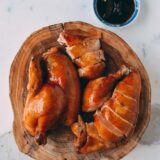
Soy Sauce Chicken
Soy Sauce Chicken is a quintessential Chinese favorite, found hanging under heat lamps in many Chinatown restaurant windows. Check out our authentic recipe.
Servings: 6 servings
Calories: 371kcal
Ingredients
- 1 whole chicken (about 4 pounds/1.8kg; preferably buddhist-style, never frozen)
- 1/4 cup salt
- 2 teaspoons neutral oil (such as vegetable, canola, or avocado oil)
- 7 slices ginger
- 2 scallions (cut into 3-inch/8cm pieces and smashed flat)
- 3 whole star anise
- 3/4 cup Chinese rose wine (mei gui lu)
- 3/4 cup Shaoxing wine
- 2 cups light soy sauce
- 1/2 cup dark soy sauce
- 1 3/4 cups sugar
- 12 cups water
Instructions
- Take your chicken out of the refrigerator an hour before you plan to cook. Remove the giblets, and thoroughly rinse the chicken inside and out. If the skin looks rough or you still see patches of a thin, waxy yellow layer on top of the skin, use your salt to rub the chicken all over to clean it, reserving the salt.
- Grab your stock pot. It will ideally be a tall, narrow pot that will just fit the chicken, since it should be totally submerged in the cooking liquid (if you use a larger pot, you'll need to increase all the ingredients proportionally to create more cooking liquid). Put it over medium low heat, and add the oil and ginger.
- Let the ginger caramelize for about 30 seconds. Then add the scallions and cook another 30 seconds. Add the star anise, rose wine, and Shaoxing wine. Bring to a simmer to let some of the alcohol cook off. Add the light soy sauce, dark soy sauce, sugar, salt, and water. Bring to a simmer again and cook on low heat for another 20 minutes.
- Increase the heat to bring the liquid to a slow boil (i.e. a little stronger than a simmer, but not a rolling boil). Use a large roasting fork inserted into the chicken cavity to lower the chicken slowly into the pot breast side up. Make sure any air pockets in the cavity fill up completely with liquid. The chicken should be entirely submerged at this point.
- Once the chicken goes in, the cooking liquid will cool down. Let it cook for about 5 minutes at medium high heat. Next, use your large fork to carefully lift the chicken out of the water and empty the liquid inside the cavity, which will be cooler than the liquid surrounding the chicken. Lower the chicken back into the pot, making sure once again that there aren't any air pockets in the cavity. If the chicken is not completely submerged, periodically baste the exposed area with cooking liquid.
- Bring the liquid back up to a lazy simmer, which should take about 5 minutes. Cover and keep it at this slow simmer (just below boiling - the liquid will be about 210°F/99°C) for 25 minutes. If the chicken (breast side up) is exposed and not submerged you can baste the chicken with the liquid a few times during this 25 minutes of cooking. You can also turn the chicken over (breast side down) at the halfway point (after 13 mins) and turn the chicken back over breast side up after the full 25 minutes.
- Turn off the heat, keeping the pot covered, and let the chicken sit (breast side up) in the pot for another 25 minutes (slightly less time for a smaller chicken, slightly more time for a chicken larger than 4 pounds). Use a meat thermometer inserted into the thickest part of the thigh to confirm it's reached 165°F/74°C. It's good to check a couple of times in different places because you don't want to undercook or overcook the chicken. Transfer the chicken to a plate and let it rest for 10 to 15 minutes before cutting.
Video
Notes
- Make sure you let the chicken come up to temperature after taking it out of the refrigerator, about 1 to 2 hours. This allows it to cook evenly. Cooking a cold chicken right out of the refrigerator will result in the chicken being underdone near the bone and overdone near the surface.
- After you turn the heat off, the longer you leave the chicken in the sauce, the more flavor it will absorb and the darker the chicken will get, but make sure you don’t overcook it! You can always serve braising sauce on the side at the table.
- If you don’t have a meat thermometer, you can lift the chicken out of the liquid and poke the thigh with a skewer or chopstick. If the juices are still pink, then the chicken needs more time.
- You can freeze the sauce/cooking liquid for use again later (though you may have to add more water and re-season the sauce).
- You can also make this recipe with chicken leg quarters, wings, drumsticks or split chicken breasts and reduce the cooking time accordingly, since they cook faster. Braising liquid ingredients can be reduced proportionally if cooking chicken parts. For example, you could make half of the cooking liquid and cook the parts in batches.
Nutrition
Calories: 371kcal | Carbohydrates: 8g | Protein: 28g | Fat: 23g | Saturated Fat: 6g | Cholesterol: 109mg | Sodium: 770mg | Potassium: 312mg | Fiber: 1g | Sugar: 7g | Vitamin A: 245IU | Vitamin C: 3.1mg | Calcium: 35mg | Iron: 1.7mg