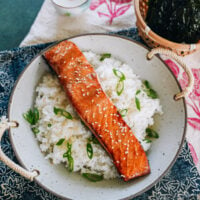
Miso Salmon
This Miso Salmon is unfussy to make, but restaurant-quality in flavor, with a light sweetness and lots of savory umami. We bet it makes it into your rotation of salmon recipes!
Servings: 3
Calories: 407kcal
Ingredients
- 1 ½-2 lb salmon fillet (we prefer skin-on salmon)
- 2 tablespoons white miso paste
- 2 tablespoons mirin
- 1 tablespoon soy sauce
- 1 teaspoon sesame oil
- 1 teaspoon honey
- 2 teaspoons neutral oil (such as canola, vegetable, or avocado oil)
Instructions
- Pat the salmon dry with a paper towel. If you have a single large fillet, cut it into 2-4 smaller pieces to make 6- to 8-ounce fillets. The more surface area for the marinade, the better! For this recipe, we like to leave the skin on.
- In a shallow dish large enough to fit all the salmon comfortably, whisk together the white miso paste, mirin, soy sauce, sesame oil, honey, and oil. Add the salmon filets and use your hands to coat them in the marinade. Cover and marinate in the fridge for 1-4 hours.
- About 15-20 minutes before you’re ready to cook the salmon, position a rack in the upper third of your oven and preheat it to 400°F/200°C. Use your hands to wipe excess marinade from the salmon, as too thick a layer will be harder to brown. Transfer the salmon to a baking sheet lined with non-stick foil or parchment paper.
- For 1-inch thick salmon fillets, bake for about 7-9 minutes. For 1.5-inch thick fillets, bake for a total of 10-12 minutes. Then switch on your oven’s max broiler setting and let the salmon get burnished and golden, another 2-3 minutes, watching constantly to make sure it doesn’t burn. Reduce the total cooking time by 1-2 minutes if you like rarer salmon. Regardless of your preferred doneness, if you’re using a thermometer, remove the salmon when the probe inserted in the center of the salmon filet registers five degrees shy of your target. As soon as it reaches your desired temperature, move it to a serving plate rather than keeping it on the baking sheet.
Notes
- If you don't want to cut the salmon filet into smaller 6-8 ounce portions, and leave it in say 14-16 oz. pieces or 1 larger filet, the salmon will take a couple minutes longer to cook. Depending on your oven, it may not broil as evenly.
- Cold salmon straight out of the refrigerator may take 1-2 minutes longer to cook than salmon that's been sitting on a sheet pan for 20 minutes while you do other kitchen tasks
- Be aware that salmon will residually cook from the heat of the pan even once it leaves the oven so if it seems like it's just done, it's better to take it out of the oven rather than let it go for too long and end up with overcooked salmon.
Nutrition
Calories: 407kcal | Carbohydrates: 10g | Protein: 47g | Fat: 19g | Saturated Fat: 3g | Polyunsaturated Fat: 7g | Monounsaturated Fat: 7g | Trans Fat: 0.01g | Cholesterol: 125mg | Sodium: 801mg | Potassium: 1155mg | Fiber: 1g | Sugar: 5g | Vitamin A: 101IU | Vitamin C: 0.01mg | Calcium: 35mg | Iron: 2mg